
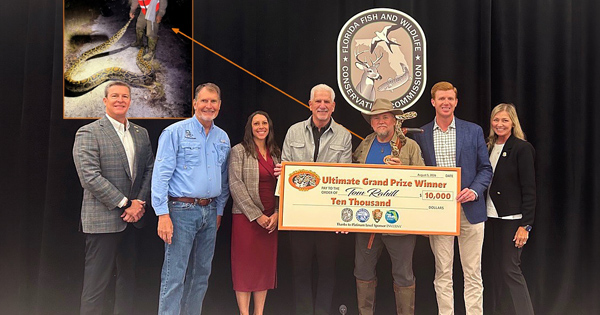
Today, the Florida Fish and Wildlife Conservation Commission (FWC) and partners announced the results and winners of the 2026 Florida Python Challenge™, an event intended to raise awareness about invasive species while engaging the public in Everglades conservation through removal of invasive Burmese pythons. Over the course of the 10-day event, 907 Python Challenge participants from 30 different states, as well as from Canada and Vietnam, collectively removed 280 invasive Burmese pythons from south Florida.
A highlight of this year’s event was the return of Everglades National Park as a partner and one of eight official Python Challenge competition locations. This year’s Ultimate Grand Prize winner of $10,000 was Tom Rahill, who removed 96 Burmese pythons during the competition — all of which were removed from Everglades National Park, contributing directly to Everglades conservation. The longest python of the competition measured 16 feet, 5 inches, and was removed by Rahm Levinson at Everglades National Park. Additional winners for longest pythons and most pythons removed in the Professional, Novice, and Military categories, are detailed below.
“The number of invasive pythons removed from the Everglades during the 2026 Florida Python Challenge is a major victory for Florida’s native wildlife and a testament to what can be accomplished through strong partnerships and public participation,” said FWC Chairman Rodney Barreto. “The 2026 Florida Python Challenge was a resounding success, made possible by the dedication of our staff, the generous support of our partners, the continued leadership of Gov. DeSantis and the commitment of the many competitors who participated in this year’s event. With more than 1,600 pythons removed through Florida Python Challenge events to date and more than 19,000 removed by FWC and South Florida Water Management District contractors since 2017, these collective efforts continue to reduce the threat Burmese pythons pose to Florida’s native wildlife and ecosystems.”
The 2026 Florida Python Challenge was hosted by the FWC and the South Florida Water Management District, working closely with partners at the National Park Service and the Fish & Wildlife Foundation of Florida.
“Congratulations to the 2026 winners of the Florida Python Challenge! Removing Burmese pythons from this ecosystem is critical to the survival of the native species that call this area home,” said South Florida Water Management District Governing Board Member “Alligator Ron” Bergeron. “We continue to advance Everglades restoration efforts thanks to the support of Governor Ron DeSantis, and we’ll keep doing everything we can to protect this important ecosystem. We appreciate our partners at the Florida Fish and Wildlife Conservation Commission and Everglades National Park as we continue to work together to raise awareness about invasive species. The Python Challenge is a great way for the public to get involved in the protection of the Everglades and I want to thank everyone who participated in the 2026 Florida Python Challenge. Every python removed is making a difference. Long live the Everglades!”
"The Florida Python Challenge shows what is possible when we all come together around a shared conservation goal,” said Nick Wiley, executive director of the Fish & Wildlife Foundation of Florida. “Each python removed helps conserve the native wildlife that makes the Everglades so extraordinary. We are proud to support this important effort and congratulate this year’s winners and thank all who took part."
“We extend our gratitude to the many people involved in this year’s Florida Python Challenge, including all the staff and volunteers whose hard work helped make this yet another success,” said FWC Executive Director Roger Young. “An event of this magnitude is only possible thanks to the support of Gov. DeSantis and our sponsors, and the continued close collaboration with our partners at the South Florida Water Management District, the National Park Service, and the Fish & Wildlife Foundation of Florida.”
2026 Florida Python Challenge Prize Winners:
ULTIMATE GRAND PRIZE ($10,000): Tom Rahill; 96 pythons
This is awarded to the participant who removes the most pythons as part of the competition.
PROFESSIONAL
- Most Pythons Prize ($2,500): Christina Kraus; 36 pythons
- Most Pythons Runner-Up Prize ($1,500): Taylor Stanberry; 34 pythons
- Longest Python Prize ($1,000): Rahm Levinson; 16 feet, 5 inches
NOVICE
- Most Pythons Prize ($2,500): Bart Shreve; 9 pythons
- Most Pythons Runner-Up Prize ($1,500): Michael Marousky; 4 pythons
- Longest Python Prize ($1,000): Vincent Poole; 8 feet, 2 inches
MILITARY – Active Duty and Veteran
- Most Pythons Prize ($2,500): Stephen Payton – U.S. Army; 3 pythons
- Most Pythons Runner-Up Prize ($1,500): Jonathan Miller – U.S. Air Force; 2 pythons
- Longest Python Prize ($1,000): Jeffery “Heath” Roser – U.S. Army; 8 feet, 7 inches
About Invasive Burmese Pythons:
Burmese pythons are not native to Florida and negatively impact native species. They are found primarily in and around the Everglades ecosystem in south Florida, where they prey on birds, mammals and other reptiles. A female Burmese python can lay 50 to 100 eggs at a time. Since the year 2000, almost 28,000 wild Burmese pythons have been removed from Florida’s environment and reported to the FWC.
In addition to the annual Florida Python Challenge, python removal opportunities are available year-round on 32 Commission-managed lands and Burmese pythons may be humanely killed on private lands at any time with landowner permission — no permit or hunting license required. The FWC encourages people to remove and humanely kill invasive pythons from private lands whenever possible. For more information on Burmese pythons, visit MyFWC.com/Python.
The public can also help by reporting pythons and other nonnative snakes, tegus and monitor lizards to the FWC’s Invasive Species Hotline at 888-IVE-GOT1 (888-483-4681), and by reporting sightings of other nonnative fish and wildlife online at IveGot1.org or by downloading the free IveGot1 smartphone app. More information on nonnative species can be found at MyFWC.com/Nonnatives.