Water Quality Improvement
Everglades Stormwater Treatment Areas Quarterly Performance Update
The South Florida Water Management District is committed to delivering clean water to the Everglades and is complying with all regulatory limits and requirements. The State of Florida operates Everglades Stormwater Treatment Areas (STAs) to improve water quality and reduce nutrient pollution.
Read the June 2026 Quarterly Performance Update
Read the September 2026 Quarterly Performance Update
Significant Water Quality Improvement in the Everglades
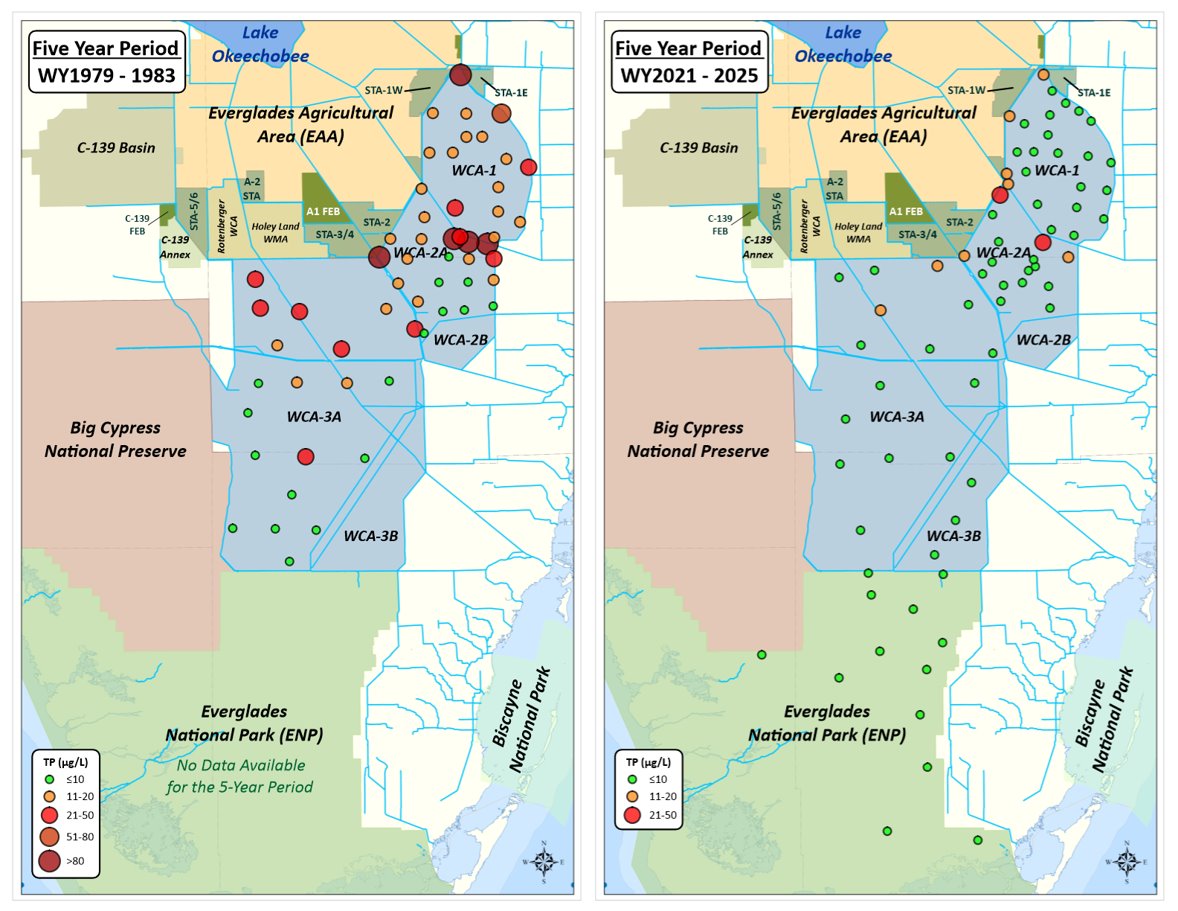
For Water Year 2025, more than 98% of the Everglades Protection Area achieved phosphorous levels meeting state water quality standards (≤10 parts per billion), marking one of the best results on record. With the completion of the Restoration Strategies projects and several Everglades STA refurbishment projects, significant water quality improvements continue to be achieved in the Everglades.
Click on the Significant Water Quality Improvement in the Everglades flyer for more information.
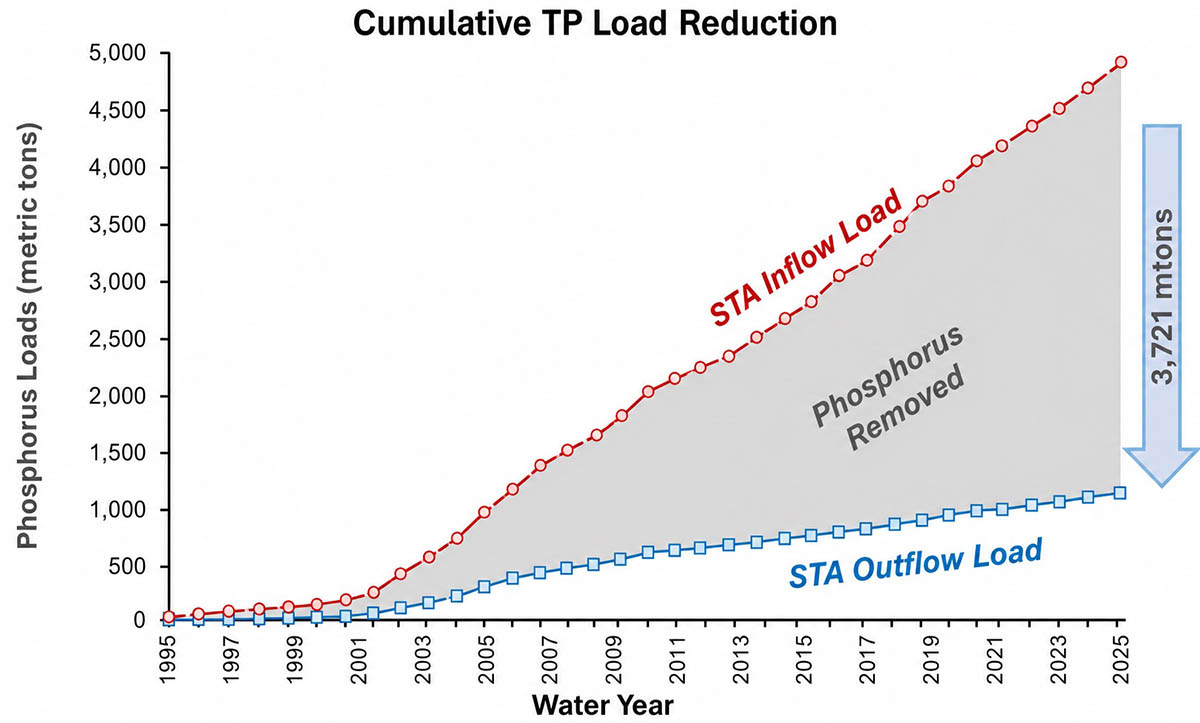
Over the past 31 years, the Everglades STAs have treated nearly 29 million acre-feet of water (approximately 9.4 trillion gallons) and retained 3,700 metric tons of total phosphorus with a 78% total phosphorus load reduction.
Water Year 2025 Performance
In Water Year 2025 (WY2025; May 1, 2024– April 30, 2025), the Everglades STAs treated over 1.2 million acre-feet of water and retained 188 metric tons of total phosphorus (TP), resulting in an 81% total phosphorus load reduction, with an outflow flow-weighted mean total phosphorus concentration of 29 micrograms per liter (µg/L). Over a quarter of the inflow, 344,600 acre-feet, came from Lake Okeechobee.
Successes to Date
(As of WY2025)
- Everglades STAs have treated approximately 29 million acre-feet of water or 9.4 trillion gallons
- Retained 3,700 metric tons of total phosphorus
- 78% total phosphorus load reduction
Stormwater Treatment Areas (STAs)
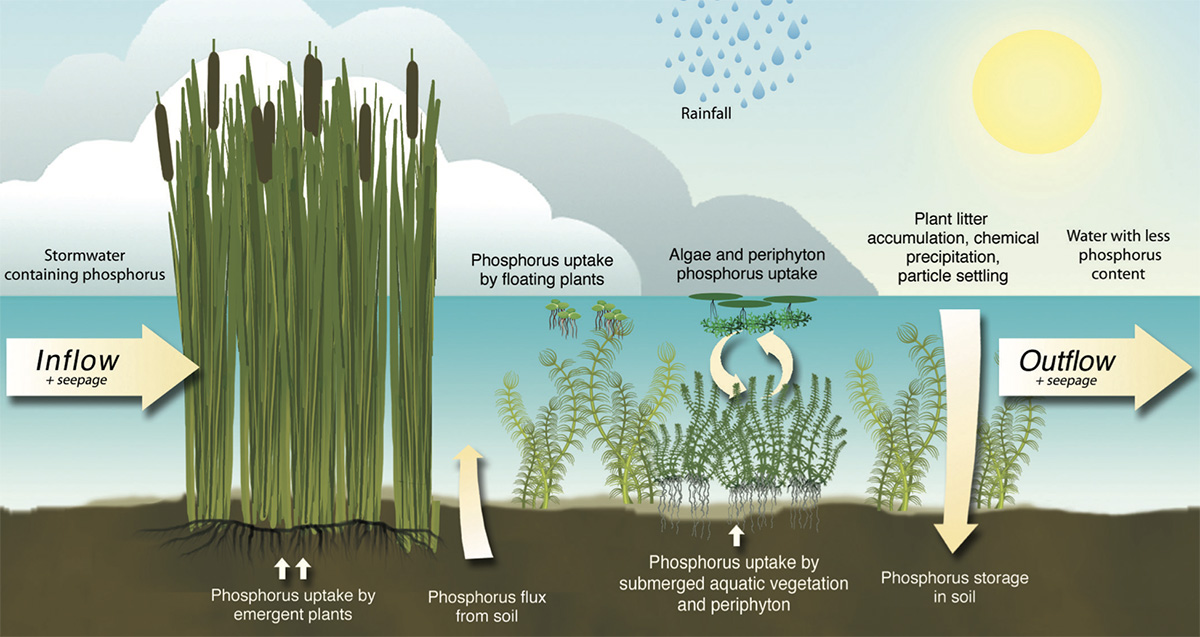
Stormwater Treatment Areas, or STAs, are constructed wetlands that remove and store nutrients through plant growth and the accumulation of dead plant material that is slowly converted to a layer of peat soil. STAs are comprised of parcels of land with compartments or cells with different plants predominating in each cell. Emergent plants, like cattails, pickerel weed and bulrush, remove nutrients and store them in peat-like soils as they decay. Submerged plants, including chara, southern naiad and hydrilla, also take phosphorus directly from the water in STAs.
Periphyton, which includes algae and bacteria found on or in the emergent and submerged vegetation, are another very important component of STAs that remove nutrients from the water. Typically, water is moved first through cells with emergent vegetation, then through cells with submergent vegetation. Water moves from one cell or compartment to the next, and at each stage gets cleaner.
There are many treatment wetlands all over the country and the world, built at different scales for different purposes. The STAs built to improve the quality of water entering the Everglades system south of Lake Okeechobee are the largest of their kind in the world.
An annual summary of STA performance is available in the annual South Florida Environmental Report.
Why Florida Built STAs
STAs remove excess nutrients in the water, such as fertilizer, through plant growth and accumulation of dead plant material in the soil. These excess nutrients, if not removed, can cause undesirable plants such as cattails to grow in the Everglades, crowding out native wetland plants and degrading the ecosystem. Nutrient concentrations, particularly phosphorus, were naturally ultra-low in the Everglades.
The STAs have dramatically reduced the concentrations of phosphorus in Everglades-bound water. STAs are continually monitored and maintained to maximize water treatment capacity. The South Florida Water Management District has also constructed storage features called flow equalization basins (FEBs) that further optimize the ability of Everglades STAs to treat water.
The Role of Vegetation in the STAs
- Helps slow down flow.
- Provides surface for periphyton/microbial colonization and activity.
- Nutrients are retained through uptake, settling and burial.
- Provides nutrient storage.
STAs – By the Numbers
Over 5.6 million pounds of nitrogen and 933,000 pounds of phosphorus are now removed from Florida's waterways on an annual basis, marking a major reduction in nutrient pollution.
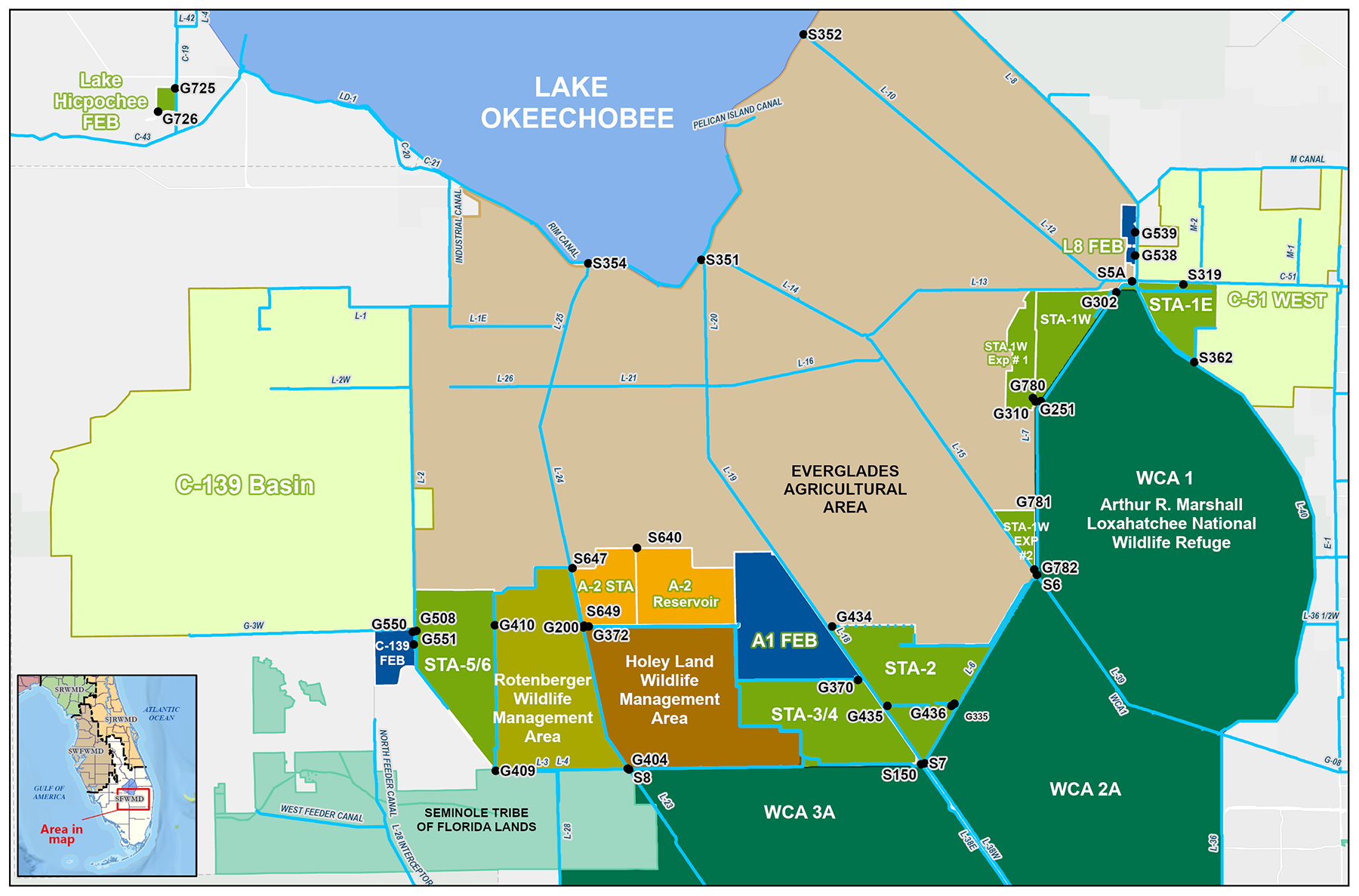
- STA-1 East, 5,000 acres, northeast of the Arthur R. Marshall Loxahatchee National Wildlife Refuge
- STA-1 West, 12,700 acres, northwest of the Arthur R. Marshall Loxahatchee National Wildlife Refuge
- STA-2, 15,500 acres, west of Water Conservation Area 2
- STA-3/4, 16,300 acres in western Palm Beach County, the largest constructed wetland in the world
- STA-5/6, 14,300 acres in Hendry County, west of Rotenberger Wildlife Management Area
STA Operations
- Water quality is continually monitored by District scientists
- Operational decisions are made based on real-time data
- Scientists and technicians consistently visit water quality monitoring stations
Agricultural Best Management Practices
Categories of practices include:
- Nutrient management to determine nutrient needs and sources and manage nutrient applications (including manure) to minimize impacts to water resources.
- Irrigation management to address the method and scheduling of irrigation to reduce water and nutrient losses to the environment.
- Water resource protection using buffers, setbacks and swales to reduce or prevent the transport of sediments and nutrients from production areas to water bodies.
The Florida Department of Agriculture and Consumer Services (FDACS) develops and adopts BMPs by rule for different types of agricultural commodities. Florida law provides for agricultural producers to reduce their impacts to water quality through the implementation of applicable BMPs adopted by FDACS.
EAA Best Management Practices
The South Florida Water Management District supports the implementation of the EAA Best Management Practices (BMPs) Program.
The program is required by the Everglades Forever Act. It necessitates EAA Basin permittees implement BMPs and collectively reduce total phosphorus loads in basin runoff in the current water year by 25 percent compared to the total phosphorus loads that occurred during a historic base period, prior to the BMPs program being implemented.
In Water Year 2026, the EAA Basin achieved a total phosphorus load reduction of 65 percent compared to the base period.
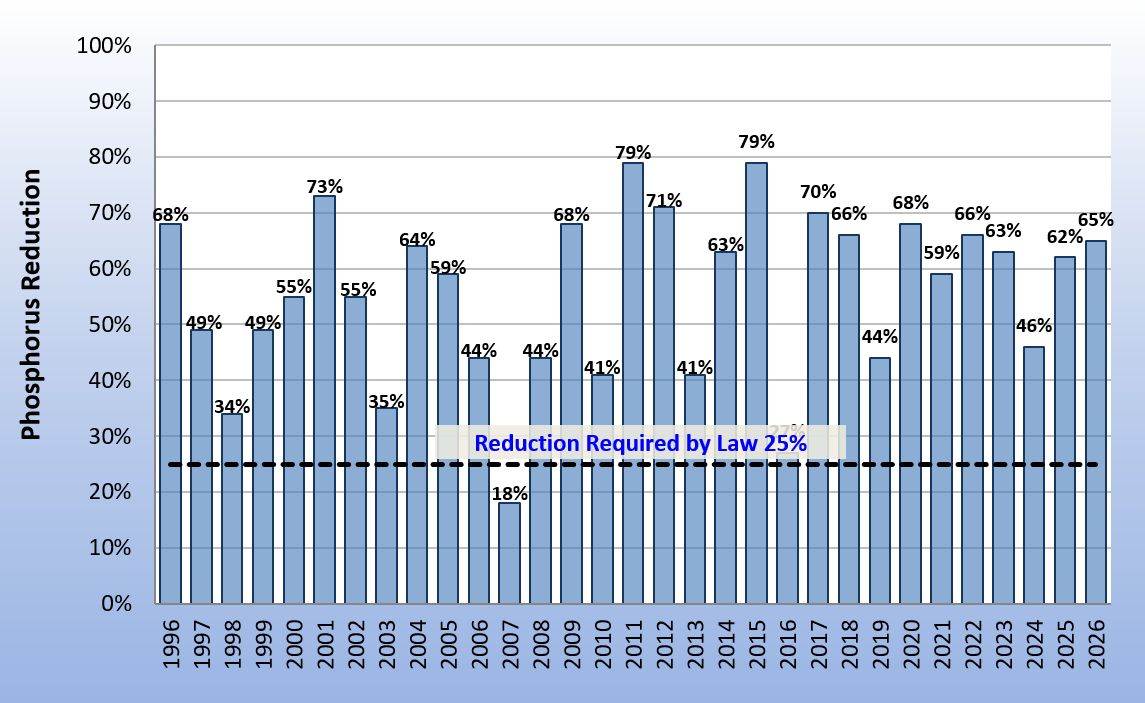
For over a decade, water flowing from farmlands in the Everglades Agricultural Area (EAA) achieved phosphorus reductions that exceeded those required by law. The performance requirements have been met each year since the initial determination in Water Year 1996 with an average long-term reduction of 57 percent.
Executive Director’s Presentation from August 2026 Governing Board Meeting
Watch the August 2026 Governing Board Meeting